---
title: "AUC Types and Integration Methods"
---
```{r setup, include=FALSE}
library(PKNCA)
library(dplyr)
library(ggplot2)
conflicted::conflicts_prefer(dplyr::filter, dplyr::select, .quiet = TRUE)
# Shared dataset for this page: oral theophylline, subject 1
d_one <- as.data.frame(Theoph) |>
filter(Subject == "1") |>
rename(time = Time, subject = Subject)
d_dose <- data.frame(subject = "1", dose = Theoph$Dose[1] * Theoph$Wt[1], time = 0)
o_conc <- PKNCAconc(d_one, conc ~ time | subject)
o_dose <- PKNCAdose(d_dose, dose ~ time | subject, route = "extravascular")
```
## AUC types
PKNCA offers four families of AUC — AUClast, AUCall, AUCinf (in observed and predicted flavors), and partial/interval AUC — each answering a different question. They differ in where integration ends and in how concentrations below the limit of quantification (BLQ) are treated:
| Parameter | End point | BLQ treatment | When to use |
|---|---|---|---|
| `auclast` | Last measurable concentration | BLQs after last non-BLQ are ignored | Default; most studies |
| `aucall` | Last measured timepoint | Post-last-measurable BLQs treated as 0 | When you want to include the BLQ tail |
| `aucinf.obs` | Extrapolated to ∞ (using observed Clast) | — | When half-life is reliable |
| `aucinf.pred` | Extrapolated to ∞ (using predicted Clast from λz fit) | — | When Clast is noisy |
| `aucint.*` | Any user-defined time window | — | Partial AUC, bioequivalence |
For a worked example computing these AUC flavors on a full dataset, see the [AUC Calculation with PKNCA vignette](https://humanpred.github.io/pknca/articles/v05-auc-calculation-with-PKNCA.html).
### AUClast vs AUCall
Subject 1's profile ends on a measurable sample (t = 24.37), so there is no BLQ tail and `auclast` equals `aucall` on the raw data. To show the difference, this demo appends a synthetic BLQ tail (concentrations reported as 0 at t = 26 and 28) to a **copy** of the data:
```{r}
# Copy of subject 1's profile with a synthetic BLQ tail (reported as 0)
d_one_blq <- d_one |>
  select(subject, time, conc) |>
  mutate(subject = as.character(subject)) |>
  bind_rows(data.frame(subject = "1", time = c(26, 28), conc = 0))

o_conc_blq <- PKNCAconc(d_one_blq, conc ~ time | subject)

auc_compare <- data.frame(
  start    = 0,
  end      = Inf,
  auclast  = TRUE,
  aucall   = TRUE
)

o_nca_blq <- pk.nca(PKNCAdata(o_conc_blq, o_dose, intervals = auc_compare))

as.data.frame(o_nca_blq) |>
  filter(PPTESTCD %in% c("auclast", "aucall")) |>
  select(PPTESTCD, PPORRES)
```
> `aucall` ≥ `auclast` when there are post-last-measurable BLQ timepoints, since those are treated as 0 and add a small triangle to the AUC — here the triangle from Clast at t = 24.37 down to 0 at t = 26.
---
## Partial AUC (AUCint)
For bioequivalence or exposure-in-a-window calculations, use `aucint.*` parameters.
These calculate AUC over an exact time window, interpolating concentrations at the boundaries if needed.
```{r}
# AUC from 0 to 4h and 0 to 12h on the same profile
partial_intervals <- data.frame(
  start         = c(0,  0),
  end           = c(4, 12),
  aucint.last   = TRUE   # AUC to the last obs within window (or interpolated boundary)
)

o_data_partial <- PKNCAdata(o_conc, o_dose, intervals = partial_intervals)
o_nca_partial  <- pk.nca(o_data_partial)

as.data.frame(o_nca_partial) |>
  filter(PPTESTCD == "aucint.last") |>
  select(start, end, PPTESTCD, PPORRES)
```
**All partial AUC variants:**
| Parameter | End concentration | Dose-aware boundary | Extrapolation |
|---|---|---|---|
| `aucint.last` | Last observed in window | No | None |
| `aucint.all` | Last observed, BLQs as 0 | No | None |
| `aucint.inf.obs` | Extrapolated to ∞, observed Clast | No | λz-based tail |
| `aucint.inf.pred` | Extrapolated to ∞, predicted Clast | No | λz-based tail |
| `aucint.last.dose` | Same as `.last` | **Yes** | None |
| `aucint.all.dose` | Same as `.all` | **Yes** | None |
| `aucint.inf.obs.dose` | Same as `.inf.obs` | **Yes** | λz-based tail |
| `aucint.inf.pred.dose` | Same as `.inf.pred` | **Yes** | λz-based tail |
> **Note:** `aucint.inf.pred` requires that `lambda.z` has been estimated (i.e. that the terminal slope is calculable from the data window).
The `.dose` variants use **dose-aware interpolation** (`interp.extrap.conc.dose()`) at the interval start and end. This matters when the interval boundary coincides with a dose time — the `.dose` variant correctly handles the before/after concentration jump. The full decision rules are in the [dose-aware interpolation and extrapolation vignette](https://humanpred.github.io/pknca/articles/v21-methods-for-dose-aware-interpolation-and-extrapolation.html).
```{r}
# All partial AUC variants over a single window
all_partial <- data.frame(
  start                 = 0,
  end                   = 8,
  aucint.last           = TRUE,
  aucint.all            = TRUE,
  aucint.inf.obs        = TRUE,
  aucint.inf.pred       = TRUE,
  aucint.last.dose      = TRUE,
  aucint.all.dose       = TRUE,
  aucint.inf.obs.dose   = TRUE,
  aucint.inf.pred.dose  = TRUE
)

o_nca_all_partial <- pk.nca(PKNCAdata(o_conc, o_dose, intervals = all_partial))
as.data.frame(o_nca_all_partial) |>
  filter(grepl("^aucint", PPTESTCD)) |>
  select(PPTESTCD, PPORRES)
```
---
## Concentration interpolation at interval boundaries
When a requested interval boundary (e.g. `end = 5`) falls between two observed timepoints, PKNCA interpolates the concentration at that boundary before computing AUC — handled internally by `interp.extrap.conc()`.
The interpolation method matches the AUC method:
- `"linear"` → linear interpolation
- `"lin-log"` → linear interpolation before Tmax, log-linear after Tmax
- `"lin up/log down"` → log-linear interpolation on the descending phase
```{r}
# end = 5 falls between observed samples t = 3.82 and t = 5.10 for subject 1
interp_interval <- data.frame(start = 0, end = 5, auclast = TRUE)
o_nca_interp <- pk.nca(PKNCAdata(o_conc, o_dose, intervals = interp_interval))
as.data.frame(o_nca_interp) |>
  filter(PPTESTCD == "auclast") |>
  select(start, end, PPTESTCD, PPORRES)
```
For boundaries that coincide with a dose time, the `.dose` variants above use dose-aware interpolation instead — see the [Dose-aware interpolation chapter](dose-aware-interpolation.qmd).
---
## Percent extrapolation (%AUCextrap)
When using `aucinf`, you should check what fraction was extrapolated beyond the last observation.
A high `aucpext` means the terminal phase was poorly characterized.
```{r}
pext_interval <- data.frame(
  start        = 0,
  end          = Inf,
  auclast      = TRUE,
  aucinf.obs   = TRUE,
  aucpext.obs  = TRUE,
  aucpext.pred = TRUE
)

o_nca_pext <- pk.nca(PKNCAdata(o_conc, o_dose, intervals = pext_interval))
as.data.frame(o_nca_pext) |>
  filter(grepl("^auc", PPTESTCD)) |>
  select(PPTESTCD, PPORRES)
```
Here about 31.5% of `aucinf.obs` is extrapolated — well above the conventional 20% acceptance limit. Note that `pk.nca()` computes `aucpext` but does **not** flag anything on its own: the `exclude` column (not shown above) is all `NA` despite the high extrapolation. Flagging is a manual step with `exclude()` after `pk.nca()`:
```{r}
o_nca_pext_excl <- exclude(
  o_nca_pext,
  reason = "aucpext.obs > 20%",
  FUN    = exclude_nca_max.aucinf.pext()
)
# Show the flagged rows
as.data.frame(o_nca_pext_excl) |>
  filter(!is.na(exclude)) |>
  select(PPTESTCD, PPORRES, exclude)
```
The `aucinf` results and the parameters derived from them (including `aucpext` itself) are now flagged. Because `FUN` supplies its own exclusion text, the recorded reason is the function's `"aucpext > 20"` rather than the `reason =` string.
The 20% default comes from the `max.aucinf.pext` option — but only the **global** option: called with no argument, `exclude_nca_max.aucinf.pext()` reads `PKNCA.options("max.aucinf.pext")`. A per-object setting such as `PKNCAdata(options = list(max.aucinf.pext = 10))` never reaches the exclusion function (and does not make `pk.nca()` flag anything by itself). To flag at a different threshold, pass it to the function directly: `exclude_nca_max.aucinf.pext(10)`.
---
## Integration methods
The integration method controls how the area of each trapezoid is computed between consecutive timepoints. Each rule, including the zero-concentration fallbacks, is derived in the [AUC integration methods vignette](https://humanpred.github.io/pknca/articles/v23-auc-integration-methods.html).
```{r}
# Numeric comparison of the three methods on one subject
methods <- c("linear", "lin-log", "lin up/log down")

results <- lapply(methods, function(m) {
  o <- pk.nca(PKNCAdata(o_conc, o_dose,
                        intervals = data.frame(start=0, end=Inf, auclast=TRUE),
                        options   = list(auc.method = m)))
  as.data.frame(o) |>
    filter(PPTESTCD == "auclast") |>
    mutate(method = m)
}) |> bind_rows()

results |> select(method, PPORRES) |>
  rename(auclast = PPORRES)
```
### Method details
**Linear trapezoidal (`"linear"`)**
Uses the standard trapezoidal rule throughout:
$$\text{AUC}_{t_i \to t_{i+1}} = \frac{(C_i + C_{i+1})}{2} \times (t_{i+1} - t_i)$$
Overestimates during the descending phase (gives too much weight to the higher concentration).
**Lin-log (`"lin-log"`)**
Uses **linear** integration from start up to Tmax, and **log-linear** integration from Tmax onward:
$$\text{AUC}_{t_i \to t_{i+1}} = \frac{(C_i - C_{i+1})}{\ln C_i - \ln C_{i+1}} \times (t_{i+1} - t_i) \quad \text{(post-Tmax)}$$
The switch point is Tmax (not whether concentrations are rising or falling), so any post-Tmax secondary peak is integrated log-linearly even if concentrations are rising. Falls back to linear for any interval where either endpoint is zero. Not recommended — `"lin up/log down"` is almost always preferable as it switches on actual direction rather than Tmax.
**Lin up / log down (`"lin up/log down"`) — default**
Hybrid: linear trapezoidal on the ascending phase (when $C_{i+1} \geq C_i$), log-linear on the descending phase (when $C_{i+1} < C_i$). Best of both worlds for most PK profiles.
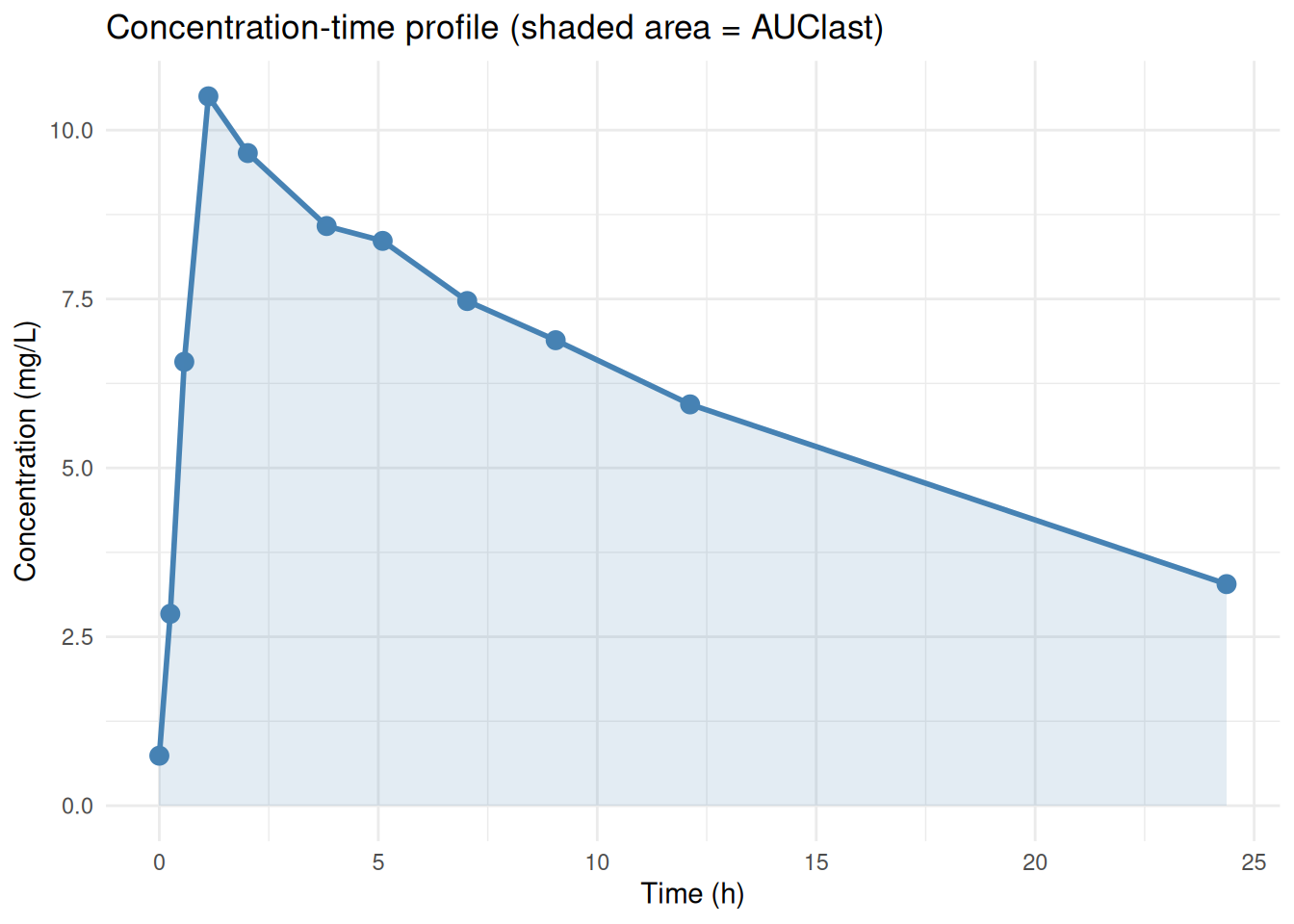
```{r}
# Profile with AUClast shaded
d_plot <- d_one |>
  filter(conc > 0) |>
  arrange(time)

ggplot(d_plot, aes(x = time, y = conc)) +
  geom_line(colour = "steelblue", linewidth = 1) +
  geom_point(size = 3, colour = "steelblue") +
  geom_area(alpha = 0.15, fill = "steelblue") +
  labs(title = "Concentration-time profile (shaded area = AUClast)",
       x = "Time (h)", y = "Concentration (mg/L)") +
  theme_minimal()
```
### When to use which method
| Study type | Recommended method | Notes |
|---|---|---|
| Most oral/extravascular | `"lin up/log down"` (default) | Linear on ascending phase, log-linear on declining phase |
| IV bolus | `"lin up/log down"` (default) | Profile is entirely declining, so log-linear is used throughout — equivalent to `"lin-log"` for pure bolus but without the Tmax ambiguity |
| IV infusion with smooth decline | `"lin up/log down"` | Concentrations rise during infusion (linear) then fall after end of infusion (log-linear) |
| Regulatory (some agencies) | `"linear"` | Some health authorities require the linear trapezoidal rule throughout |
| Highly irregular profiles with zeros | `"linear"` | Zeros alone are handled per-segment by the log methods (they fall back to linear for those segments); choose `"linear"` when you want the same rule everywhere, e.g. for some regulatory templates |
| Never recommended | `"lin-log"` | Switches at Tmax rather than on direction of change — gives wrong method for post-Tmax secondary peaks |
---
## AUMC — area under the first moment curve
The **area under the first moment curve** (AUMC) weights concentrations by time and is used to compute mean residence time (MRT):
$$\text{AUMC} = \int_0^{t_{\mathrm{last}}} t \cdot C(t) \, dt$$
| Parameter | Meaning |
|---|---|
| `aumclast` | AUMC from 0 to last measurable concentration |
| `aumcall` | AUMC from 0 to last, treating BLQ as 0 |
| `aumcinf.obs` | AUMC extrapolated to ∞, observed Clast |
| `aumcinf.pred` | AUMC extrapolated to ∞, predicted Clast |
```{r}
aumc_interval <- data.frame(
  start         = 0,
  end           = Inf,
  aumclast      = TRUE,
  aumcall       = TRUE,
  aumcinf.obs   = TRUE,
  aumcinf.pred  = TRUE
)

o_nca_aumc <- pk.nca(PKNCAdata(o_conc, o_dose, intervals = aumc_interval))

as.data.frame(o_nca_aumc) |>
  filter(grepl("^aumc", PPTESTCD)) |>
  select(PPTESTCD, PPORRES)
```
---
## Other interval parameters
These interval parameters are requested the same way as AUCs and often accompany them.
### AUC above a threshold (`aucabove.*`)
`aucabove.*` computes the area under the curve above a reference concentration — useful for quantifying exposure above a minimum effective concentration (for the duration above it, see `time_above`).
| Parameter | Reference concentration |
|---|---|
| `aucabove.trough.all` | Ctrough (concentration at end of interval) |
| `aucabove.predose.all` | Cpredose (concentration at interval start) |
```{r}
# ctrough requires an observation exactly at the interval end —
# subject 1's last sample is at t = 24.37 (end = 24 would give ctrough = NA)
above_interval <- data.frame(
  start              = 0,
  end                = 24.37,
  aucabove.trough.all  = TRUE,
  aucabove.predose.all = TRUE,
  ctrough              = TRUE,
  cstart               = TRUE
)

o_nca_above <- pk.nca(PKNCAdata(o_conc, o_dose, intervals = above_interval))

as.data.frame(o_nca_above) |>
  filter(PPTESTCD %in% c("aucabove.trough.all", "aucabove.predose.all", "ctrough", "cstart")) |>
  select(PPTESTCD, PPORRES)
```
### Time above a threshold (`time_above`)
`time_above` computes the total duration (in time units) for which the concentration exceeds a specified threshold. The threshold is set via the `conc_above` column in the intervals data frame.
```{r}
# Time above 2 mg/L
time_above_interval <- data.frame(
  start      = 0,
  end        = Inf,
  time_above = TRUE,
  conc_above = 2       # threshold concentration (same units as your data)
)

o_nca_ta <- pk.nca(PKNCAdata(o_conc, o_dose, intervals = time_above_interval))

as.data.frame(o_nca_ta) |>
  filter(PPTESTCD == "time_above") |>
  select(PPTESTCD, PPORRES)
```
### Total dose (`totdose`)
`totdose` is the total amount administered within the analysis interval — it is extracted from the dose object rather than computed from concentrations. Useful as a reference column in your results data frame.
```{r}
totdose_interval <- data.frame(
  start    = 0,
  end      = Inf,
  totdose  = TRUE,
  auclast  = TRUE
)

o_nca_td <- pk.nca(PKNCAdata(o_conc, o_dose, intervals = totdose_interval))

as.data.frame(o_nca_td) |>
  filter(PPTESTCD %in% c("totdose", "auclast")) |>
  select(PPTESTCD, PPORRES)
```
---
### Cav over a specific interval (`cav.int.*`)
`cav.int.*` computes the average concentration over the requested interval, without requiring a full dosing-interval design. The numerator is the corresponding `aucint.*` flavor computed over the window; the divisor is always `end − start`.
> **Warning:** because the divisor is always `end − start`, requesting any `cav.int.*` parameter with `end = Inf` divides a finite AUC by infinity and reports 0 — always use a finite `end`.
| Parameter | Numerator (`aucint.*` flavor over the window) |
|---|---|
| `cav.int.last` | `aucint.last` — stops accumulating area at the last measurable concentration |
| `cav.int.all` | `aucint.all` — post-Tlast BLQ values treated as 0 |
| `cav.int.inf.obs` | `aucint.inf.obs` — λz extrapolation beyond Tlast, observed Clast |
| `cav.int.inf.pred` | `aucint.inf.pred` — λz extrapolation beyond Tlast, predicted Clast |
```{r}
# Two finite windows: 0–24 h lies inside the observed profile (Tlast = 24.37 h),
# 0–48 h extends past it
cav_interval <- data.frame(
  start             = 0,
  end               = c(24, 48),
  cav.int.last      = TRUE,
  cav.int.all       = TRUE,
  cav.int.inf.obs   = TRUE,
  cav.int.inf.pred  = TRUE
)

o_nca_cav <- pk.nca(PKNCAdata(o_conc, o_dose, intervals = cav_interval))

as.data.frame(o_nca_cav) |>
  filter(grepl("^cav.int", PPTESTCD)) |>
  select(start, end, PPTESTCD, PPORRES)
```
Over 0–24 h all four flavors integrate the same observed curve, so they coincide. Over 0–48 h they separate: the `.inf` forms extrapolate the tail beyond Tlast with λz (differing from each other only through the observed vs. predicted Clast — nearly identical here), while `.last` and `.all` stop accumulating area at Tlast yet still divide by the full 48 h, which is why their average drops from 6.08 to 3.07 mg/L.
---
::: {.callout-note icon=false appearance="minimal"}
**pkgdown reference:** [PKNCAconc()](https://humanpred.github.io/pknca/reference/PKNCAconc.html) · [PKNCAdose()](https://humanpred.github.io/pknca/reference/PKNCAdose.html) · [PKNCAdata()](https://humanpred.github.io/pknca/reference/PKNCAdata.html) · [pk.nca()](https://humanpred.github.io/pknca/reference/pk.nca.html) · [interp.extrap.conc.dose()](https://humanpred.github.io/pknca/reference/interp.extrap.conc.html) · [interp.extrap.conc()](https://humanpred.github.io/pknca/reference/interp.extrap.conc.html) · [exclude()](https://humanpred.github.io/pknca/reference/exclude.html) · [exclude_nca_max.aucinf.pext()](https://humanpred.github.io/pknca/reference/exclude_nca.html)
:::