flowchart TD
    A["All points after Tmax"] --> B["Try subsets: last 3, last 4, ..., all"]
    B --> C["Fit log-linear regression to each"]
    C --> D{"Valid fit?<br/>λz > 0<br/>≥ min.hl.points points"}
    D -- yes --> E["Compute adj.R²"]
    D -- no --> F["Discard subset"]
    E --> G["Select longest window within adj.r.squared.factor of best adj.R²"]
    G --> H["Return λz, half.life, R², n.points"]
5 Half-Life and Terminal Phase
5.1 How PKNCA estimates λz
PKNCA uses curve stripping: it systematically evaluates every terminal window ending at the last point (last 3 points, last 4, and so on up to the full tail), fits log-linear regression to each subset, and selects the best fit based on adjusted R².
The selection criterion uses a tolerance window: among all subsets that yield a valid fit (λz > 0), PKNCA picks the one with the most points whose adjusted R² is within adj.r.squared.factor of the best adjusted R²:
selected n = the largest n whose adj.R² is within
adj.r.squared.factorof the best adj.R²
The small tolerance (adj.r.squared.factor, default 0.0001) means: prefer longer windows (more points → more accurate λz) unless the longer window’s adj.R² is noticeably worse than the best. This is a model-selection tolerance, not a per-point penalty added to R².
The algorithm is described step-by-step in the Half-Life Calculation vignette.
5.2 Basic half-life output
hl_interval <- data.frame(
  start             = 0,
  end               = Inf,
  half.life         = TRUE,
  lambda.z          = TRUE,
  lambda.z.n.points = TRUE,
  lambda.z.time.first = TRUE,
  r.squared         = TRUE,
  adj.r.squared     = TRUE,
  span.ratio        = TRUE
)

o_nca <- pk.nca(PKNCAdata(o_conc, o_dose, intervals = hl_interval))

as.data.frame(o_nca) |>
  filter(PPTESTCD %in% c("half.life", "lambda.z", "lambda.z.n.points",
                          "lambda.z.time.first", "adj.r.squared", "span.ratio")) |>
  select(subject, PPTESTCD, PPORRES) |>
  tidyr::pivot_wider(names_from = PPTESTCD, values_from = PPORRES) |>
  arrange(subject)
# A tibble: 12 × 7
subject lambda.z adj.r.squared lambda.z.time.first lambda.z.n.points
<ord> <dbl> <dbl> <dbl> <dbl>
1 6 0.0878 0.998 2.03 7
2 7 0.0883 0.998 6.98 4
3 8 0.0815 0.989 3.53 6
4 11 0.0955 1.000 9.03 3
5 3 0.102 0.999 9 3
6 2 0.104 0.996 7.03 4
7 4 0.0993 0.998 9.02 3
8 9 0.0825 0.999 8.8 3
9 12 0.110 0.999 9.03 3
10 10 0.0750 0.999 9.38 3
11 1 0.0485 1.000 9.05 3
12 5 0.0866 0.998 7.02 4
# ℹ 2 more variables: half.life <dbl>, span.ratio <dbl>What each output means:
| Parameter | Meaning |
|---|---|
lambda.z |
Terminal elimination rate constant (h⁻¹) |
half.life |
ln(2) / λz |
lambda.z.n.points |
Number of points used in the selected regression |
lambda.z.time.first |
First timepoint included in the regression window |
r.squared / adj.r.squared |
Fit quality of the selected regression |
span.ratio |
(time of last − time of first regression point) / half.life — post-hoc quality flag |
5.3 Quality filters
PKNCA provides one filter enforced during fitting, several post-hoc exclusion thresholds applied after fitting with exclude(), and one fitting option:
Important distinction: Only
min.hl.pointsis enforced insidepk.calc.half.life()— with too few points,half.lifeisNAimmediately.min.hl.r.squaredandmin.span.ratioare not consulted during fitting; they are thresholds forexclude()calls afterpk.nca().
5.3.1 Minimum number of points (enforced during fitting)
# Default: 3 points minimum — the only filter that makes half.life NA during pk.nca()
o_data_4pts <- PKNCAdata(o_conc, o_dose, intervals = hl_interval,
                          options = list(min.hl.points = 4))
o_nca_4pts  <- pk.nca(o_data_4pts)

as.data.frame(o_nca_4pts) |>
  filter(PPTESTCD %in% c("half.life", "lambda.z.n.points")) |>
  select(subject, PPTESTCD, PPORRES) |>
  tidyr::pivot_wider(names_from = PPTESTCD, values_from = PPORRES) |>
  arrange(subject)
# A tibble: 12 × 3
subject lambda.z.n.points half.life
<ord> <dbl> <dbl>
1 6 7 7.89
2 7 4 7.85
3 8 6 8.51
4 11 4 7.22
5 3 6 7.36
6 2 4 6.66
7 4 4 7.32
8 9 4 8.70
9 12 5 6.67
10 10 4 9.46
11 1 5 14.4
12 5 4 8.005.3.2 R² threshold (post-hoc exclusion via exclude())
min.hl.r.squared sets the minimum unadjusted R² threshold. It has no effect during pk.nca(); use it with exclude_nca_min.hl.r.squared() after fitting. Theoph’s log-linear fits are all excellent — every subject’s R² is above 0.99 — so a conventional threshold like 0.95 flags nothing here; this demonstration uses a stricter 0.995 to make the effect visible:
# Compute half-life for all subjects
o_nca_r2 <- pk.nca(PKNCAdata(o_conc, o_dose, intervals = hl_interval))

# Then flag results with unadjusted R² < 0.995
o_nca_r2_excl <- exclude(
  o_nca_r2,
  reason = "r.squared < 0.995",
  FUN    = exclude_nca_min.hl.r.squared(0.995)
)
Loading required namespace: testthatas.data.frame(o_nca_r2_excl) |>
filter(PPTESTCD %in% c("half.life", "r.squared")) |>
select(subject, PPTESTCD, PPORRES) |>
tidyr::pivot_wider(names_from = PPTESTCD, values_from = PPORRES) |>
arrange(subject)# A tibble: 12 × 3
subject r.squared half.life
<ord> <dbl> <dbl>
1 6 0.998 7.89
2 7 0.999 7.85
3 8 0.991 8.51
4 11 1.000 7.26
5 3 0.999 6.77
6 2 0.997 6.66
7 4 0.999 6.98
8 9 0.999 8.41
9 12 0.999 6.29
10 10 1.000 9.25
11 1 1.000 14.3
12 5 0.999 8.00The flag itself is recorded in the exclude column. Subject 8 (R² = 0.991) is the only one below the threshold:
as.data.frame(o_nca_r2_excl) |>
  filter(!is.na(exclude)) |>
  distinct(subject, exclude)
# A tibble: 1 × 2
subject exclude
<ord> <chr>
1 8 r.squared < 0.995For the stricter adjusted R² filter: exclude_nca_min.hl.adj.r.squared(min).
5.3.3 Span ratio threshold (post-hoc exclusion via exclude())
min.span.ratio has no effect during pk.nca(); use it with exclude_nca_span.ratio():
# Flag half-lives with span.ratio < 2
o_nca_span_excl <- exclude(
  o_nca_r2,
  reason = "span.ratio < 2",
  FUN    = exclude_nca_span.ratio(2)
)

as.data.frame(o_nca_span_excl) |>
  filter(PPTESTCD %in% c("half.life", "span.ratio")) |>
  select(subject, PPTESTCD, PPORRES) |>
  tidyr::pivot_wider(names_from = PPTESTCD, values_from = PPORRES) |>
  arrange(subject)
# A tibble: 12 × 3
subject half.life span.ratio
<ord> <dbl> <dbl>
1 6 7.89 2.76
2 7 7.85 2.20
3 8 8.51 2.42
4 11 7.26 2.07
5 3 6.77 2.24
6 2 6.66 2.59
7 4 6.98 2.24
8 9 8.41 1.86
9 12 6.29 2.41
10 10 9.25 1.55
11 1 14.3 1.07
12 5 8.00 2.17Three subjects fall below a span ratio of 2 and are flagged in the exclude column:
as.data.frame(o_nca_span_excl) |>
  filter(!is.na(exclude)) |>
  distinct(subject, exclude)
# A tibble: 3 × 2
subject exclude
<ord> <chr>
1 9 span.ratio < 2
2 10 span.ratio < 2
3 1 span.ratio < 25.3.4 Allowing or excluding Tmax
By default Tmax is excluded from the λz regression (drug may still be distributing).
o_data_tmax <- PKNCAdata(o_conc, o_dose, intervals = hl_interval,
                          options = list(allow.tmax.in.half.life = TRUE))
o_nca_tmax  <- pk.nca(o_data_tmax)

as.data.frame(o_nca_tmax) |>
  filter(PPTESTCD %in% c("half.life", "lambda.z.n.points", "lambda.z.time.first")) |>
  select(subject, PPTESTCD, PPORRES) |>
  tidyr::pivot_wider(names_from = PPTESTCD, values_from = PPORRES) |>
  arrange(subject)
# A tibble: 12 × 4
subject lambda.z.time.first lambda.z.n.points half.life
<ord> <dbl> <dbl> <dbl>
1 6 2.03 7 7.89
2 7 6.98 4 7.85
3 8 2.02 7 8.47
4 11 9.03 3 7.26
5 3 9 3 6.77
6 2 7.03 4 6.66
7 4 9.02 3 6.98
8 9 8.8 3 8.41
9 12 9.03 3 6.29
10 10 9.38 3 9.25
11 1 9.05 3 14.3
12 5 7.02 4 8.005.4 Manually controlling which points are used
See also manual point selection in the Half-Life Calculation vignette.
5.4.1 Excluding specific points (exclude_half.life)
Mark individual observations that should never be included in the λz regression — for example, a suspected outlier or a secondary peak.
d_conc_excl <- d_conc |>
  mutate(excl_hl = ifelse(subject == "1" & time > 16, TRUE, NA))

o_conc_excl <- PKNCAconc(d_conc_excl, conc ~ time | subject,
                          exclude_half.life = "excl_hl")

o_nca_excl <- pk.nca(PKNCAdata(o_conc_excl, o_dose, intervals = hl_interval))

# Compare half.life and n.points for subject 1
bind_rows(
  as.data.frame(o_nca) |>
    filter(subject == "1", PPTESTCD %in% c("half.life", "lambda.z.n.points")) |>
    mutate(version = "default"),
  as.data.frame(o_nca_excl) |>
    filter(subject == "1", PPTESTCD %in% c("half.life", "lambda.z.n.points")) |>
    mutate(version = "late points excluded")
) |>
  select(version, PPTESTCD, PPORRES) |>
  arrange(version, PPTESTCD)
# A tibble: 4 × 3
version PPTESTCD PPORRES
<chr> <chr> <dbl>
1 default half.life 14.3
2 default lambda.z.n.points 3
3 late points excluded half.life 15.3
4 late points excluded lambda.z.n.points 3 5.4.2 Specifying the exact points (include_half.life)
Mark the exact points to fit: include_half.life bypasses curve stripping entirely and fits only the marked points. Automatic selection — including min.hl.points, adj.r.squared.factor, and allow.tmax.in.half.life — is not applied, so even a two-point fit is accepted. Useful when the regression window is pre-specified, e.g. by an analysis plan.
d_conc_incl <- d_conc |>
  mutate(incl_hl = ifelse(subject == "1" & time %in% c(9.05, 12.12), TRUE, NA))

o_conc_incl <- PKNCAconc(d_conc_incl, conc ~ time | subject,
                          include_half.life = "incl_hl")

o_nca_incl <- pk.nca(PKNCAdata(o_conc_incl, o_dose, intervals = hl_interval))
Warning: n must be > 2 for adj.r.squaredas.data.frame(o_nca_incl) |>
filter(subject == "1",
PPTESTCD %in% c("half.life", "lambda.z.n.points", "lambda.z.time.first")) |>
select(PPTESTCD, PPORRES)# A tibble: 3 × 2
PPTESTCD PPORRES
<chr> <dbl>
1 lambda.z.time.first 9.05
2 lambda.z.n.points 2
3 half.life 14.3 Note:
include_half.lifeforces the curve-stripping algorithm to always start at or before the earliest forced point. If the forced point is early in the profile, this can result in a worse fit (lower R²) — the point is still included even if it pulls the regression down.
5.5 Tobit regression for BLQ-heavy data (≥ 0.12.2)
5.5.1 Why Tobit?
In studies where drug concentrations in the terminal elimination phase are frequently below the lower limit of quantification (BLQ), ordinary least-squares (OLS) log-linear regression produces biased estimates of λz. The bias arises because OLS either:
- drops BLQ observations entirely — shrinking the regression window and losing information about the true terminal slope, or
- substitutes BLQ = 0 — which is undefined on the log scale and forces arbitrary imputation.
Tobit regression handles this correctly by treating each BLQ observation as a left-censored data point. Rather than requiring a specific concentration value, it only asserts C ≤ LLOQ. The regression uses the full profile, including censored observations, without fabricating values.
5.5.2 The key statistical difference from OLS
OLS minimizes the sum of squared residuals across observed concentrations. Tobit instead maximizes a likelihood that has two components:
- Observed concentrations (above LLOQ): contribute via the normal log-likelihood of the log-transformed concentration given the fitted log-linear line.
- BLQ observations: contribute the cumulative probability that the true (unobserved) concentration falls at or below the LLOQ, i.e.
Φ((log(LLOQ) − predicted) / σ), where Φ is the standard normal CDF and σ the residual standard deviation.
This means BLQ timepoints actively inform the slope estimate — they pull the λz estimate toward the true terminal slope — rather than being discarded.
5.5.3 When to consider Tobit
Tobit regression is most beneficial in the following situations:
- A substantial fraction of terminal-phase observations — as a rough rule of thumb (not a documented PKNCA threshold), a fifth or more — are BLQ. With few or no BLQ points, OLS and Tobit give similar estimates.
- The drug has low tissue concentrations or a short distribution half-life relative to the sampling schedule, making late timepoints frequently BLQ.
- Pediatric or geriatric studies with limited sampling windows, where sparse late-time samples are often at or near the LLOQ.
- The terminal slope is important for downstream parameters (AUC extrapolation, mean residence time) and precision matters for regulatory submissions.
5.5.4 Using Tobit directly with pk.calc.half.life() (≥ 0.12.2)
Tobit can be called directly through pk.calc.half.life() or used in the full pk.nca() pipeline (next section). For a direct call, supply the full concentration-time vector and the LLOQ (a scalar, or a vector with one value per timepoint):
# Simulated profile — concentrations at 16h and 24h are below the LLOQ of 0.1 mg/L
conc_tobit <- c(0, 2.5, 4.8, 4.2, 2.9, 1.4, 0.6, 0.05, 0.01)
time_tobit <- c(0, 0.5,   1,   2,   4,   8,  12,  16,  24)

# OLS reference
hl_ols   <- pk.calc.half.life(conc = conc_tobit, time = time_tobit, tmax = 1,
                               tlast = 24, hl_method = "log-linear")

# Tobit — includes the BLQ observations as left-censored at the scalar lloq
hl_tobit <- pk.calc.half.life(conc = conc_tobit, time = time_tobit, tmax = 1,
                               tlast = 24, lloq = 0.1, hl_method = "tobit")

# Compare
data.frame(
  method    = c("log-linear", "tobit"),
  lambda.z  = c(hl_ols$lambda.z,  hl_tobit$lambda.z),
  half.life = c(hl_ols$half.life, hl_tobit$half.life),
  n.points  = c(hl_ols$lambda.z.n.points, hl_tobit$lambda.z.n.points)
)
method lambda.z half.life n.points
1 log-linear 0.2896253 2.393255 6
2 tobit 0.2658595 2.607194 65.5.5 Tobit through the pk.nca() pipeline (≥ 0.12.2)
To run Tobit across a full dataset, declare the LLOQ on the concentration object with the lloq argument of PKNCAconc() and select the method with the hl_method option:
# Subject 1 with an assay LLOQ of 0.5 mg/L
d_conc_subset <- d_conc |> filter(subject == "1")
d_dose_subset <- d_dose |> filter(subject == "1")

o_conc_tobit <- PKNCAconc(d_conc_subset, conc ~ time | subject, lloq = 0.5)
o_dose_tobit <- PKNCAdose(d_dose_subset, dose ~ time | subject, route = "extravascular")

o_data_tobit <- PKNCAdata(
  o_conc_tobit, o_dose_tobit,
  intervals = data.frame(start = 0, end = Inf, half.life = TRUE),
  options   = list(hl_method = "tobit")
)
o_nca_tobit <- pk.nca(o_data_tobit)

as.data.frame(o_nca_tobit) |>
  filter(PPTESTCD %in% c("half.life", "lambda.z.n.points_blq",
                          "tobit_residual", "adj_tobit_residual")) |>
  select(PPTESTCD, PPORRES)
# A tibble: 4 × 2
PPTESTCD PPORRES
<chr> <dbl>
1 lambda.z.n.points_blq 0
2 half.life 14.3
3 tobit_residual 0.000167
4 adj_tobit_residual 0.0000834None of subject 1’s terminal-phase samples fall below this LLOQ (lambda.z.n.points_blq is 0), so the Tobit estimate matches the OLS fit here — the example shows the wiring, and the Tobit-specific outputs appear alongside the usual half-life results.
Tobit adds new output parameters to the results:
| Parameter | Description |
|---|---|
lambda.z.n.points_blq |
Number of BLQ points included in the Tobit regression |
tobit_residual |
Estimated residual standard deviation of the Tobit fit (log-concentration scale) |
adj_tobit_residual |
Adjusted Tobit residual (analogous to adjusted R²) |
5.6 lambda.z.corrxy — regression correlation
lambda.z.corrxy (≥ 0.12.2) returns the Pearson correlation between time and log-concentration for the points used in the λz regression. It is a unitless diagnostic — values close to −1 indicate a strong, clean terminal slope.
hl_corrxy_interval <- data.frame(
  start              = 0,
  end                = Inf,
  half.life          = TRUE,
  lambda.z           = TRUE,
  lambda.z.corrxy    = TRUE,
  r.squared          = TRUE,
  adj.r.squared      = TRUE
)

o_nca_corrxy <- pk.nca(PKNCAdata(o_conc, o_dose, intervals = hl_corrxy_interval))

as.data.frame(o_nca_corrxy) |>
  filter(PPTESTCD %in% c("half.life", "lambda.z.corrxy", "r.squared", "adj.r.squared")) |>
  select(subject, PPTESTCD, PPORRES) |>
  tidyr::pivot_wider(names_from = PPTESTCD, values_from = PPORRES) |>
  arrange(subject)
# A tibble: 12 × 5
subject r.squared adj.r.squared lambda.z.corrxy half.life
<ord> <dbl> <dbl> <dbl> <dbl>
1 6 0.998 0.998 -0.999 7.89
2 7 0.999 0.998 -0.999 7.85
3 8 0.991 0.989 -0.995 8.51
4 11 1.000 1.000 -1.000 7.26
5 3 0.999 0.999 -1.000 6.77
6 2 0.997 0.996 -0.999 6.66
7 4 0.999 0.998 -0.999 6.98
8 9 0.999 0.999 -1.000 8.41
9 12 0.999 0.999 -1.000 6.29
10 10 1.000 0.999 -1.000 9.25
11 1 1.000 1.000 -1.000 14.3
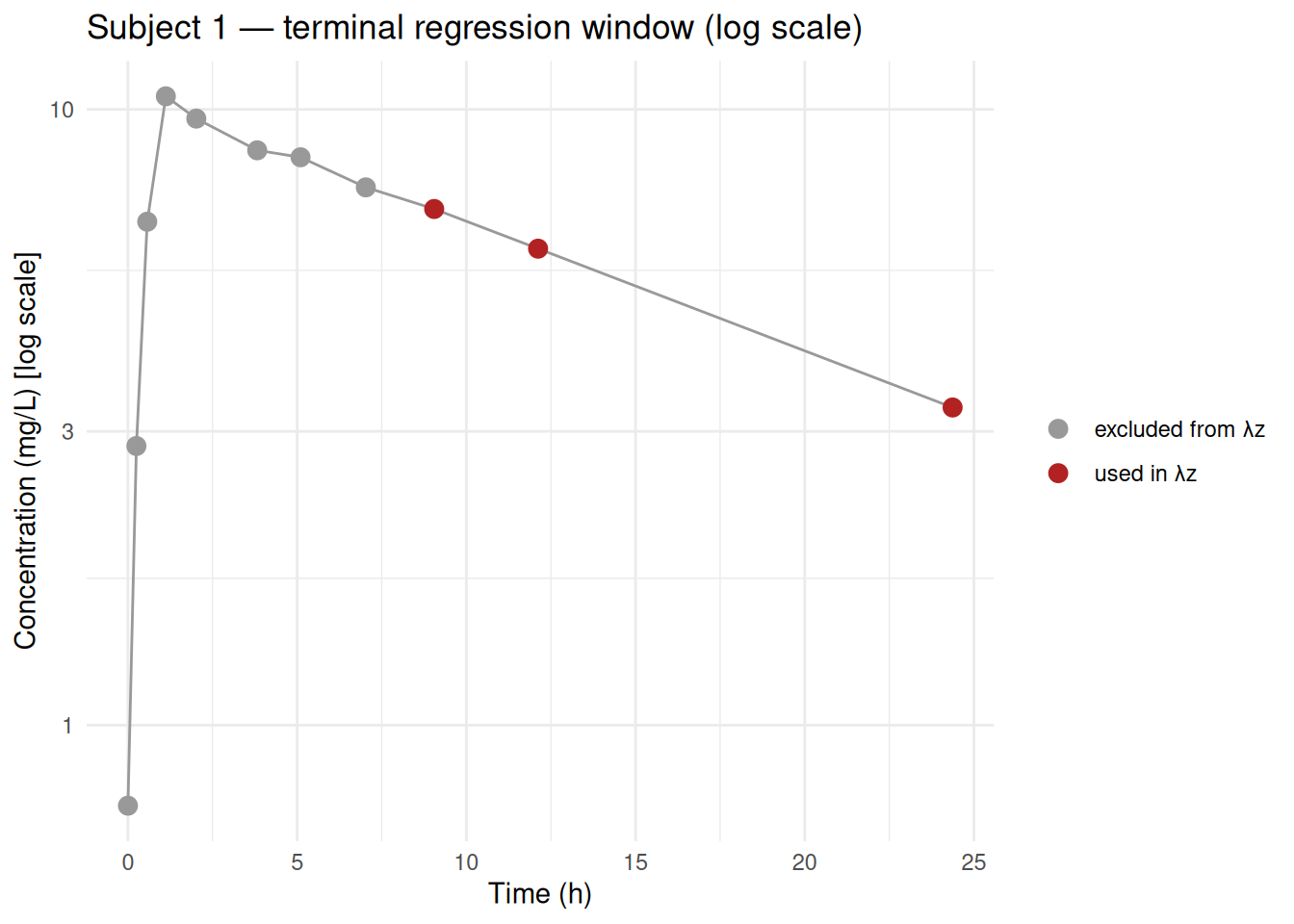
12 5 0.999 0.998 -0.999 8.005.7 Visualizing the chosen regression window
# Extract lambda.z.time.first and n.points to annotate the plot
hl_results <- as.data.frame(o_nca) |>
  filter(PPTESTCD %in% c("lambda.z.time.first", "lambda.z.n.points")) |>
  tidyr::pivot_wider(names_from = PPTESTCD, values_from = PPORRES)

# Plot subject 1 with regression window highlighted
subj1 <- d_conc |> filter(subject == "1")
win   <- hl_results |> filter(subject == "1")
start_t <- win$lambda.z.time.first

ggplot(subj1, aes(x = time, y = conc)) +
  geom_line(colour = "grey60") +
  geom_point(aes(colour = time >= start_t), size = 3) +
  scale_colour_manual(values = c("FALSE" = "grey60", "TRUE" = "firebrick"),
                      labels = c("excluded from λz", "used in λz"),
                      name = NULL) +
  scale_y_log10() +
  labs(title = "Subject 1 — terminal regression window (log scale)",
       x = "Time (h)", y = "Concentration (mg/L) [log scale]") +
  theme_minimal()