Time to steady state (TSS) is the dosing occasion (or clock time) at which pre-dose trough concentrations are no longer meaningfully rising. PKNCA provides two NCA-based methods for estimating TSS from trough concentration data collected across multiple dose occasions. Once at steady state, compute interval parameters with Multiple-Dose and Steady-State; to predict the steady-state profile from single-dose data, see Superposition.
Both methods work on trough concentrations (Ctrough = pre-dose concentration; the end of one dosing interval is the pre-dose sample of the next) collected at successive dose numbers, not full PK profiles. See also the package vignette Noncompartmental evaluation of time to steady-state.
10.2 Simulated dataset
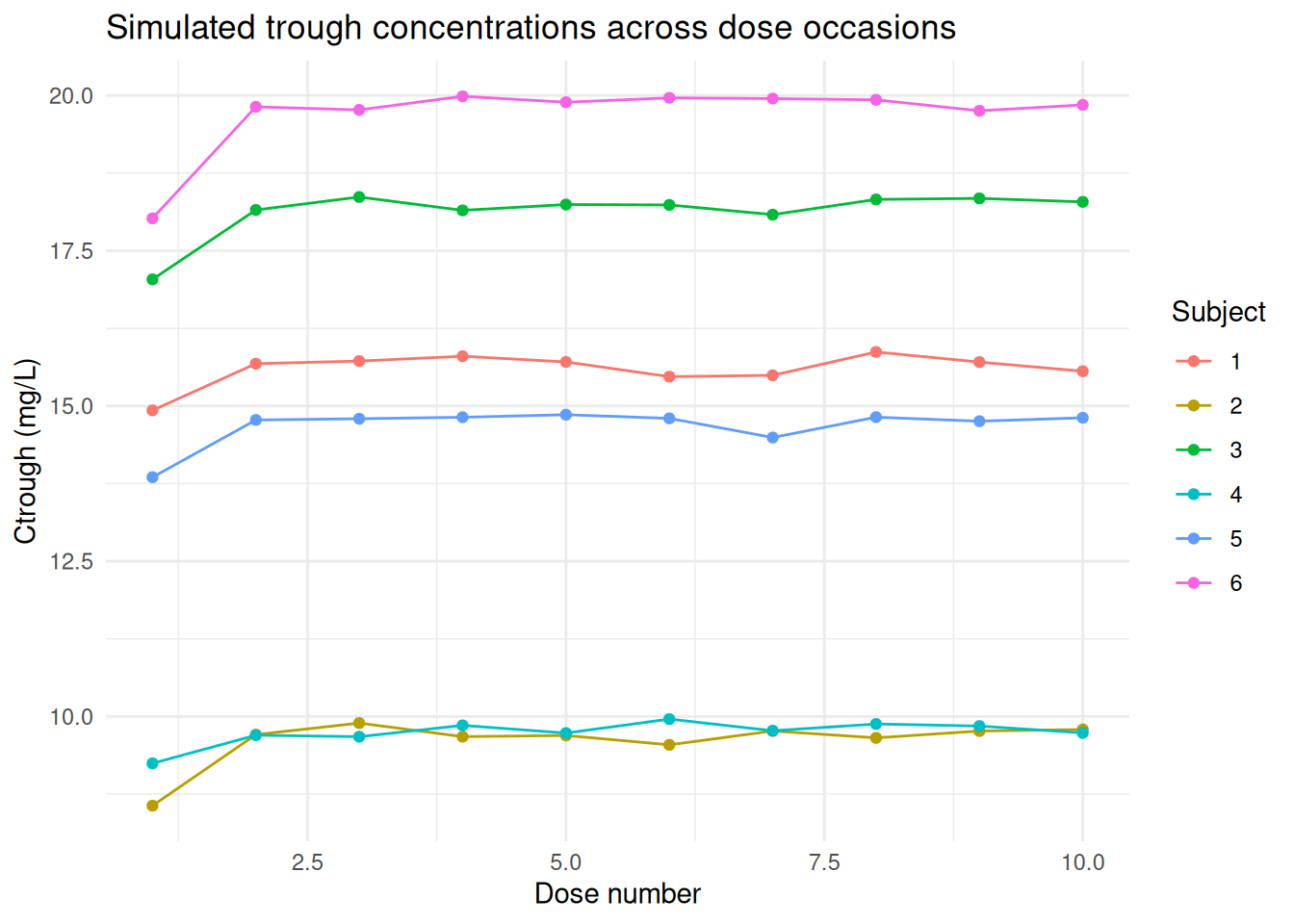
We simulate trough concentrations for 6 subjects across 10 dose occasions. Concentrations approach an individual steady-state plateau following a monoexponential rise.
set.seed(42)n_subjects <-6n_doses <-10d_tss <-data.frame(Subject =rep(1:n_subjects, each = n_doses),dose_number =rep(1:n_doses, n_subjects),ke =rep(0.1*exp(rnorm(n_subjects, 0, 0.2)), each = n_doses),Css =rep(10*exp(rnorm(n_subjects, 0, 0.3)), each = n_doses))d_tss$ctrough <- d_tss$Css * (1-exp(-d_tss$ke * d_tss$dose_number *24)) +rnorm(nrow(d_tss), 0, 0.1)ggplot(d_tss, aes(x = dose_number, y = ctrough, group = Subject, colour =factor(Subject))) +geom_line() +geom_point() +labs(title ="Simulated trough concentrations across dose occasions",x ="Dose number", y ="Ctrough (mg/L)", colour ="Subject") +theme_minimal()
Reports TSS as the dose occasion at which the predicted concentration reaches a specified fraction of Css (default: 90% = tss.fraction = 0.9).
Returns population, population-individual (popind), individual, and pooled single-model estimates (single fits one model to all data, ignoring subject differences).
Warning in nlme.formula(conc ~ ctrough.ss * (1 - exp(tss.constant * time/tss)),
: Iteration 1, LME step: nlminb() did not converge (code = 1). Do increase
'msMaxIter'!
Warning in pk.tss.monoexponential.population(modeldata, output =
intersect(c("population", : tss.monoexponential.popind was requested, but the
best model did not include a random effect for tss.  Set to NA.
tss_mono
  subject tss.monoexponential.population tss.monoexponential.popind
1       1                      0.8797774                         NA
2       2                      0.8797774                         NA
3       3                      0.8797774                         NA
4       4                      0.8797774                         NA
5       5                      0.8797774                         NA
6       6                      0.8797774                         NA
  tss.monoexponential.individual tss.monoexponential.single
1                      0.7536625                  0.8806135
2                      1.0731366                  0.8806135
3                      0.8498045                  0.8806135
4                      0.8060571                  0.8806135
5                      0.8277943                  0.8806135
6                      0.9719632                  0.8806135
Interpreting the output columns:
Column
Meaning
tss.monoexponential.population
TSS from population-level fit (one value shared across subjects)
tss.monoexponential.popind
TSS from mixed model with subject-level random effect for TSS (NA if not supported by data)
tss.monoexponential.individual
TSS from individual-level fits
tss.monoexponential.single
TSS ignoring between-subject variability
10.3.1 Changing the fraction threshold
A stricter 95% definition of steady state gives a later TSS:
Warning in nlme.formula(conc ~ ctrough.ss * (1 - exp(tss.constant * time/tss)),
: Iteration 1, LME step: nlminb() did not converge (code = 1). Do increase
'msMaxIter'!
Warning in nlme.formula(conc ~ ctrough.ss * (1 - exp(tss.constant * time/tss)),
: Singular precision matrix in level -1, block 1
Warning in pk.tss.monoexponential.population(modeldata, output =
intersect(c("population", : tss.monoexponential.popind was requested, but the
best model did not include a random effect for tss.  Set to NA.
  subject tss.monoexponential.population tss.monoexponential.popind
1       1                       1.144617                         NA
2       2                       1.144617                         NA
3       3                       1.144617                         NA
4       4                       1.144617                         NA
5       5                       1.144617                         NA
6       6                       1.144617                         NA
  tss.monoexponential.individual tss.monoexponential.single
1                      0.9805283                   1.145705
2                      1.3961661                   1.145705
3                      1.1056088                   1.145705
4                      1.0486509                   1.145705
5                      1.0769848                   1.145705
6                      1.2645547                   1.145705
10.4 Method 2: Stepwise linear (pk.tss.stepwise.linear)
A non-parametric approach: iteratively tests whether concentrations are still increasing linearly from dose occasion \(k\) onward. TSS is the earliest dose occasion at which the upward trend is no longer statistically significant.
This method is more robust when the rise to steady state is irregular or non-monoexponential.
The result is a data frame with a tss.stepwise.linear column containing the first dose occasion number where concentrations are deemed flat (or NA if steady state cannot be determined from the data).
10.5 Running both methods (pk.tss)
pk.tss() runs both methods and returns results side by side:
Warning in nlme.formula(conc ~ ctrough.ss * (1 - exp(tss.constant * time/tss)),
: Iteration 1, LME step: nlminb() did not converge (code = 1). Do increase
'msMaxIter'!
Warning in pk.tss.monoexponential.population(modeldata, output =
intersect(c("population", : tss.monoexponential.popind was requested, but the
best model did not include a random effect for tss.  Set to NA.
tss_combined
  subject tss.monoexponential.population tss.monoexponential.popind
1       1                      0.8797774                         NA
2       2                      0.8797774                         NA
3       3                      0.8797774                         NA
4       4                      0.8797774                         NA
5       5                      0.8797774                         NA
6       6                      0.8797774                         NA
  tss.monoexponential.individual tss.monoexponential.single tss.stepwise.linear
1                      0.7536625                  0.8806135                   2
2                      1.0731366                  0.8806135                   2
3                      0.8498045                  0.8806135                   2
4                      0.8060571                  0.8806135                   2
5                      0.8277943                  0.8806135                   2
6                      0.9719632                  0.8806135                   2
10.6 Key arguments
Argument
Default
Applies to
Meaning
conc
—
both
Trough concentrations (one per dose occasion per subject)
time
—
both
Dose occasion numbers or actual clock times
subject
—
both
Subject identifiers
time.dosing
—
both
Every dosing time; concentrations at these times are treated as the trough observations the models fit
type
c("monoexponential", "stepwise.linear")
pk.tss wrapper
Which method(s) to run — both by default
tss.fraction
0.9
monoexponential
Fraction of Css that defines “at steady state”
output
c("population","popind","individual","single")
monoexponential
Which output types to return
verbose
FALSE
both
Print model fitting details
Note: TSS estimation requires multiple dose occasions with consistent trough sampling. It is not applicable to single-dose studies or studies where trough collection was inconsistent.
---title: "Time to Steady State"---```{r setup, include=FALSE}library(PKNCA)library(dplyr)library(ggplot2)conflicted::conflicts_prefer(dplyr::filter, dplyr::select, .quiet =TRUE)```## What is time to steady state?**Time to steady state (TSS)** is the dosing occasion (or clock time) at which pre-dose trough concentrations are no longer meaningfully rising. PKNCA provides two NCA-based methods for estimating TSS from trough concentration data collected across multiple dose occasions. Once at steady state, compute interval parameters with [Multiple-Dose and Steady-State](multiple-dose.qmd); to predict the steady-state profile from single-dose data, see [Superposition](superposition.qmd).Both methods work on trough concentrations (Ctrough = pre-dose concentration; the end of one dosing interval is the pre-dose sample of the next) collected at successive dose numbers, not full PK profiles. See also the package vignette [Noncompartmental evaluation of time to steady-state](https://humanpred.github.io/pknca/articles/v22-time-to-steady-state.html).---## Simulated datasetWe simulate trough concentrations for 6 subjects across 10 dose occasions. Concentrations approach an individual steady-state plateau following a monoexponential rise.```{r}set.seed(42)n_subjects <-6n_doses <-10d_tss <-data.frame(Subject =rep(1:n_subjects, each = n_doses),dose_number =rep(1:n_doses, n_subjects),ke =rep(0.1*exp(rnorm(n_subjects, 0, 0.2)), each = n_doses),Css =rep(10*exp(rnorm(n_subjects, 0, 0.3)), each = n_doses))d_tss$ctrough <- d_tss$Css * (1-exp(-d_tss$ke * d_tss$dose_number *24)) +rnorm(nrow(d_tss), 0, 0.1)ggplot(d_tss, aes(x = dose_number, y = ctrough, group = Subject, colour =factor(Subject))) +geom_line() +geom_point() +labs(title ="Simulated trough concentrations across dose occasions",x ="Dose number", y ="Ctrough (mg/L)", colour ="Subject") +theme_minimal()```---## Method 1: Monoexponential (`pk.tss.monoexponential`)Fits a monoexponential approach-to-plateau model:$$C_{\text{trough}}(n) = C_{ss} \cdot \left(1 - e^{-k_{\text{tss}} \cdot n}\right)$$Reports TSS as the dose occasion at which the predicted concentration reaches a specified fraction of Css (default: 90% = `tss.fraction = 0.9`).Returns population, population-individual (popind), individual, and pooled single-model estimates (`single` fits one model to all data, ignoring subject differences).```{r}tss_mono <-pk.tss.monoexponential(conc = d_tss$ctrough,time = d_tss$dose_number,subject = d_tss$Subject,time.dosing =1:n_doses)tss_mono```**Interpreting the output columns:**| Column | Meaning ||---|---||`tss.monoexponential.population`| TSS from population-level fit (one value shared across subjects) ||`tss.monoexponential.popind`| TSS from mixed model with subject-level random effect for TSS (NA if not supported by data) ||`tss.monoexponential.individual`| TSS from individual-level fits ||`tss.monoexponential.single`| TSS ignoring between-subject variability |### Changing the fraction thresholdA stricter 95% definition of steady state gives a later TSS:```{r}# 95% of Csspk.tss.monoexponential(conc = d_tss$ctrough,time = d_tss$dose_number,subject = d_tss$Subject,time.dosing =1:n_doses,tss.fraction =0.95)```---## Method 2: Stepwise linear (`pk.tss.stepwise.linear`)A non-parametric approach: iteratively tests whether concentrations are still increasing linearly from dose occasion $k$ onward. TSS is the earliest dose occasion at which the upward trend is no longer statistically significant.This method is more robust when the rise to steady state is irregular or non-monoexponential.```{r}tss_linear <-pk.tss.stepwise.linear(conc = d_tss$ctrough,time = d_tss$dose_number,subject = d_tss$Subject,time.dosing =1:n_doses)tss_linear```The result is a data frame with a `tss.stepwise.linear` column containing the first dose occasion number where concentrations are deemed flat (or `NA` if steady state cannot be determined from the data).---## Running both methods (`pk.tss`)`pk.tss()` runs both methods and returns results side by side:```{r}tss_combined <-pk.tss(conc = d_tss$ctrough,time = d_tss$dose_number,subject = d_tss$Subject,time.dosing =1:n_doses)tss_combined```---## Key arguments| Argument | Default | Applies to | Meaning ||---|---|---|---||`conc`| — | both | Trough concentrations (one per dose occasion per subject) ||`time`| — | both | Dose occasion numbers or actual clock times ||`subject`| — | both | Subject identifiers ||`time.dosing`| — | both | Every dosing time; concentrations at these times are treated as the trough observations the models fit ||`type`|`c("monoexponential", "stepwise.linear")`|`pk.tss` wrapper | Which method(s) to run — both by default ||`tss.fraction`|`0.9`| monoexponential | Fraction of Css that defines "at steady state" ||`output`|`c("population","popind","individual","single")`| monoexponential | Which output types to return ||`verbose`|`FALSE`| both | Print model fitting details |> **Note:** TSS estimation requires **multiple dose occasions with consistent trough sampling**. It is not applicable to single-dose studies or studies where trough collection was inconsistent.---::: {.callout-note icon=false appearance="minimal"}**pkgdown reference:** [pk.tss()](https://humanpred.github.io/pknca/reference/pk.tss.html) · [pk.tss.monoexponential()](https://humanpred.github.io/pknca/reference/pk.tss.monoexponential.html) · [pk.tss.stepwise.linear()](https://humanpred.github.io/pknca/reference/pk.tss.stepwise.linear.html):::