The filename argument may be given with an sprintf() format including
"%d" to allow automatic numbering of the output filenames. Specifically, the
pattern of "%d" with an optional non-negative integer between the "%" and "d"
is searched for and if found, then the filename will be generated using that
sprintf() format. Note that also means that other requirements for
sprintf() must be met; for example, if you want a percent sign ("%") in the
filename, it must be doubled so that sprintf returns what is desired.
Usage
# S3 method for class 'gglist'
knit_print(
  x,
  ...,
  filename = NULL,
  fig_suffix = NULL,
  float_barrier_after = 10
)

# S3 method for class 'ggtibble'
knit_print(x, ...)
Arguments
- x
The gglist object
- ...
extra arguments to
knit_print()- filename
A filename with an optional "%d" sprintf pattern for saving the plots
- fig_suffix
Any text to add after the figure. Defaults to
NULL, which means "auto-select":"\n\n\\FloatBarrier\n\n"for LaTeX output whenlength(x) > float_barrier_after, otherwise"\n\n".- float_barrier_after
Numeric threshold for emitting
\FloatBarrierbetween figures in LaTeX output. Whenlength(x) > float_barrier_afterandknitr::is_latex_output()isTRUEand the user did not supplyfig_suffix,fig_suffixdefaults to"\n\n\\FloatBarrier\n\n". Has no effect on non-LaTeX output. Set toInfto disable. Defaults to10.
Details
When length(x) exceeds float_barrier_after and the output format is
LaTeX (as detected by knitr::is_latex_output()), fig_suffix defaults to
"\n\n\\FloatBarrier\n\n" instead of the usual "\n\n". This avoids the
LaTeX "Output loop—100 consecutive dead cycles" error that occurs when
the float queue (default capacity ~18) overflows. \FloatBarrier is
provided by the placeins LaTeX package, which is not loaded by default
in rmarkdown::pdf_document; add \usepackage{placeins} to the document
preamble (e.g. via header-includes in the YAML) when relying on the
auto-suffix. Pass fig_suffix explicitly to override, or set
float_barrier_after = Inf to disable the auto-suffix entirely.
Footnotes and labels
A ggtibble whose "footnote" or "label" column (see ggtibble()) is
non-empty on any row is written by knit_print() as markdown: each figure
is saved as an image and written with its caption, its footnote, and its
label as its identifier. The chunk therefore needs results = "asis"; the
ggtibble chunk option sets it, and calling knit_print() in a chunk
without it is an error. A ggtibble with no footnotes or labels renders
through the knitr plot hook exactly as before.
Of the chunk options, this route uses fig.path, label, dev (one of
the common devices; others are an error), fig.width, fig.height, dpi,
and, for LaTeX, fig.pos. It does not apply out.width, out.height,
fig.align, fig.alt, fig.cap (the captions come from the ggtibble), or
dev.args.
Captions and footnotes are markdown and pass through to pandoc: emphasis
and links work, a footnote line starting with # becomes a heading, and
raw LaTeX reaches only LaTeX output (pandoc drops it elsewhere). A caption
is joined onto one line, and unbalanced square brackets in it are escaped.
| Output | Figure | Footnote | Kept with the figure |
| LaTeX (R Markdown and Quarto) | A figure float with \label{<label>} | Inside the float, appended to the caption after a line break in \footnotesize; the short caption (for the List of Figures) is the plain caption | Yes, it is in the float |
| Quarto to Typst | A figure Div | A paragraph in 0.9em text after the Div | Yes, the Div and footnote are one unbreakable Typst block |
| HTML | An image with its caption | A Div of class figure-footnote in a smaller font directly after the figure | Not applicable (no pages) |
| Word and other pandoc formats | An image with its caption | A plain paragraph, in the body text size, directly after the figure | No: Word may break the page between them |
| knitr markdown without pandoc | An image with its caption, without an identifier | A plain paragraph directly after the figure | Not applicable |
Under Quarto, a figure whose label starts with fig- is written as a
figure Div so that @<label> cross-references resolve; other labels are
kept as given, with a warning of class ggtibble_warning_label_not_fig,
since Quarto reads @<label> without the prefix as a citation. A figure
without a label is given the identifier fig-<chunk label> (with
-<row number> for more than one row), so each figure of a multi-row
ggtibble is its own numbered figure rather than a subfigure. Do not give
such a chunk a fig- label of its own; the ggtibble chunk option leaves
it off. In R Markdown to LaTeX, cross-reference a labelled figure with
\ref{<label>}.
Figure ids must be unique within a document: an id already written by an
earlier chunk is an error of class ggtibble_error_label_duplicated. A
labelled figure's image file is <chunk label>-<label> with the device's
extension; other figures use the knitr default
<chunk label>-<row number>.
See also
Other knitters:
knit_print.gg()
Examples
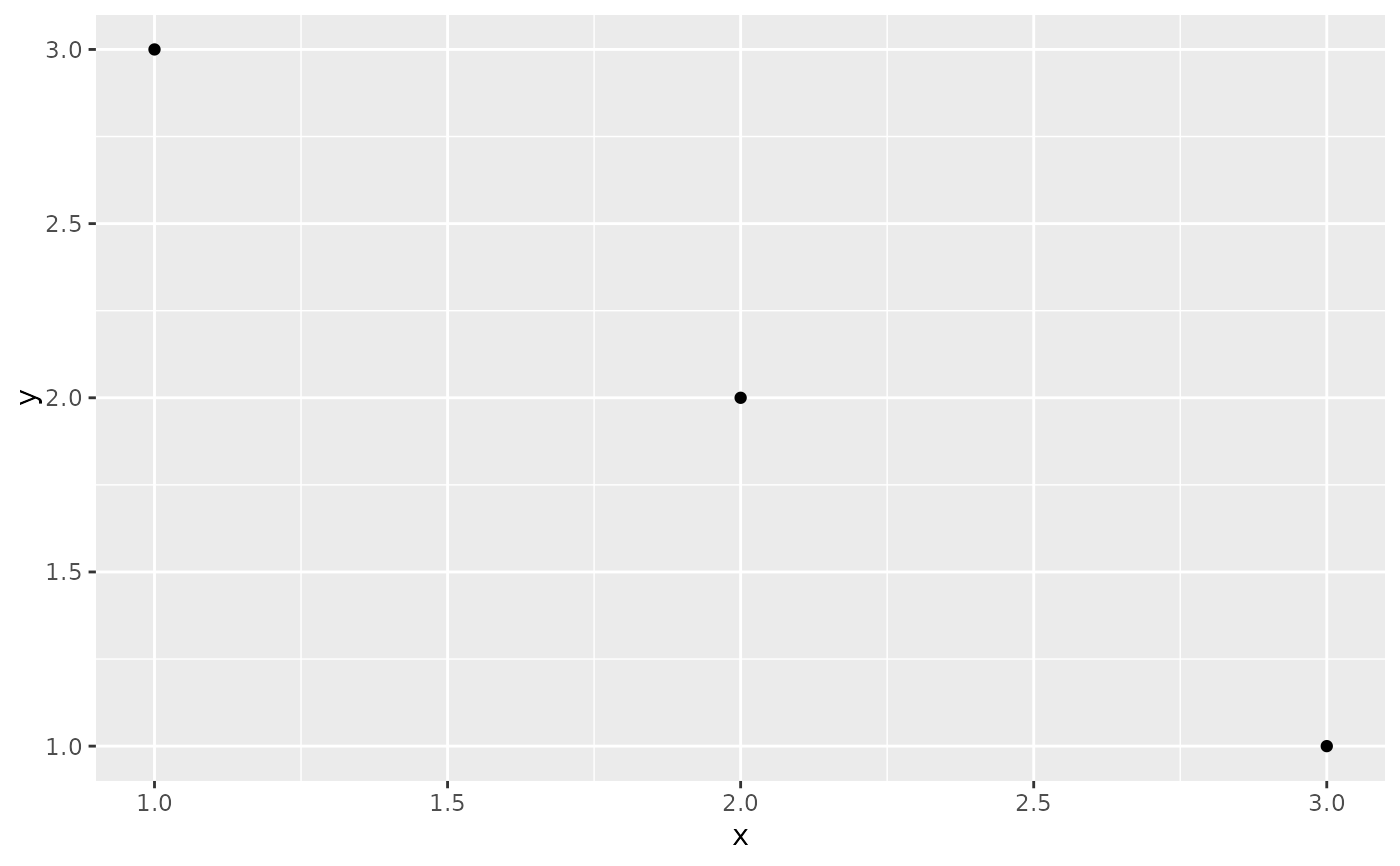
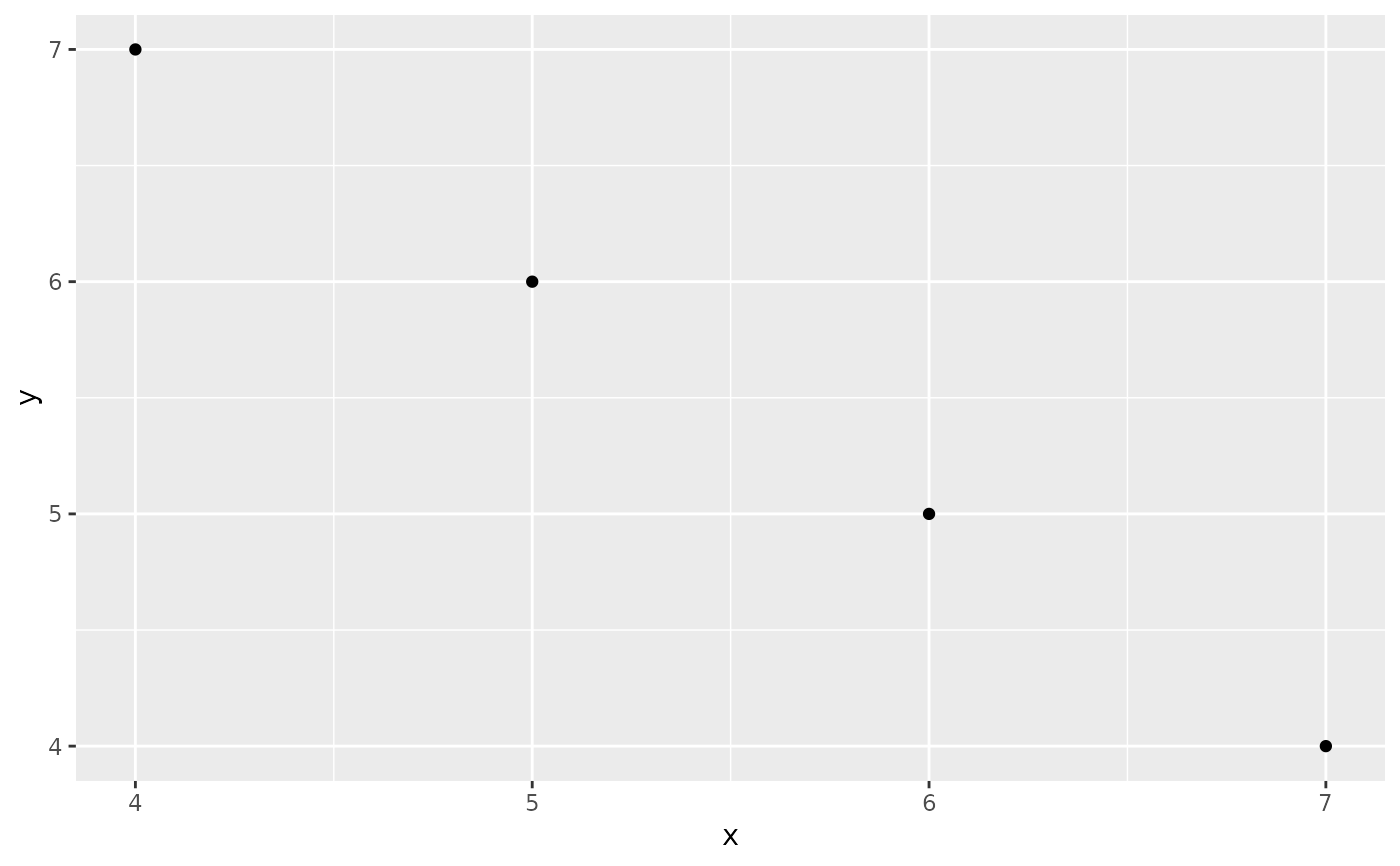
# Ensure that each figure is within its own float area
mydata <-
list(
data.frame(x = 1:3, y = 3:1),
data.frame(x = 4:7, y = 7:4)
)
p <- gglist(mydata, ggplot2::aes(x = x, y = y)) +
ggplot2::geom_point()
knit_print(p, fig_suffix = "\n\n\\FloatBarrier\n\n")
#>
#>
 #>
#>
#> \FloatBarrier
#>
#>
#>
#>
#>
#>
#>
#> \FloatBarrier
#>
#>
#>
#>
#>
 #>
#>
#> \FloatBarrier
#>
#>
#>
#>
#>
#> \FloatBarrier
#>
#>
#>